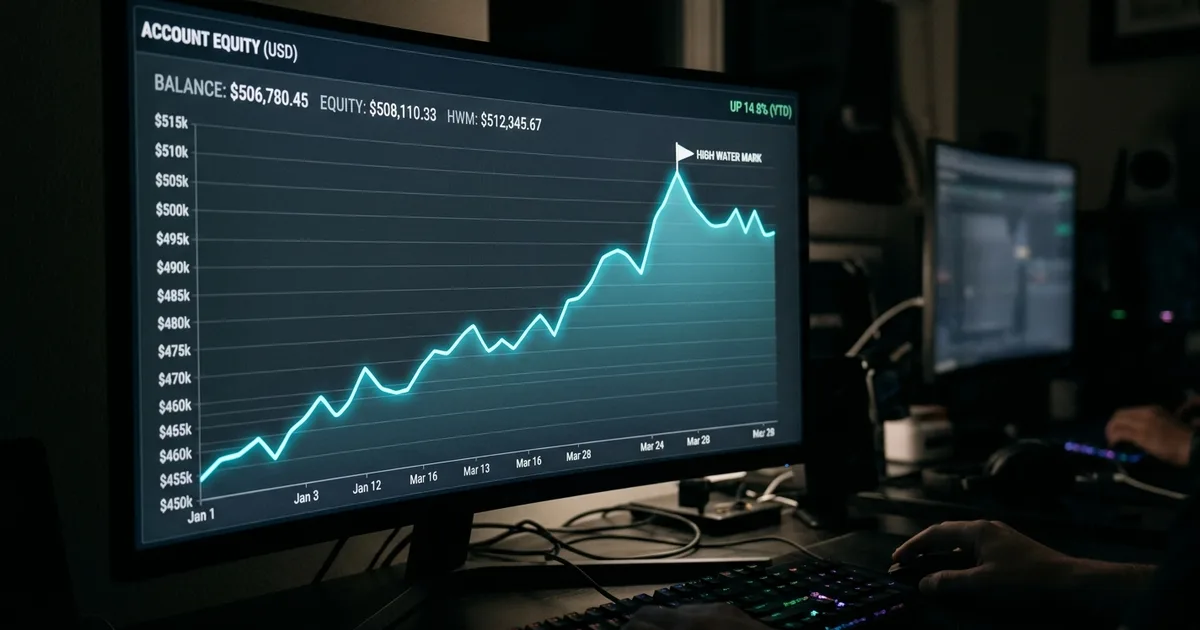
Two risk rules get treated like they're the same thing, and that mix-up ends more funded accounts than bad trades do. A daily loss limit resets every session - yesterday doesn't follow you into today. A trailing drawdown never resets down - it follows your account's highest point ever reached, and it only moves up. Knowing which one your firm uses changes how much room you actually have.
How a daily loss limit works
A daily loss limit is measured against a fixed point - usually the prior day's closing balance or the day's opening balance - and it resets at the start of every new session. Lose your limit on Tuesday and Wednesday starts clean. It's a rolling, session-by-session leash: rough as any single day can be, but it never compounds a bad week into a smaller one. The number you're allowed to lose today has nothing to do with what happened yesterday.
How a trailing drawdown works
A trailing max drawdown is measured from your account's highest balance ever reached, not from a fixed starting point. Every time you set a new high, the floor rises to sit a fixed distance beneath it - and it stays there even after you give some of that profit back. This is the part that surprises people: the floor doesn't reset when a new day starts, and it doesn't retreat when your balance does. Bank $2,000 in profit and give back $1,500 of it on an ordinary losing streak, and you can fail the account on a drawdown that never touched your original starting balance.
Left: the flat limit line resets in meaning at every day boundary - a rough day doesn't tighten tomorrow's room. Right: the floor only ever steps up, the instant a new high is set, and never comes back down.
Two charts. The Daily Loss Limit chart shows account equity crossing two day-boundary markers with one flat limit line beneath it - the account dips toward the limit late in the third day and locks for the day. The Trailing Drawdown chart shows one continuous equity curve whose floor line jumps upward each time equity sets a new high, holds flat afterward, and does not move back down even as equity later pulls back - the account eventually breaches this now-higher floor on an ordinary pullback.
Why the difference catches traders off guard
A trader who's up big feels safe, because their daily number still looks fine. What they don't see is the trailing floor quietly climbing beneath them with every new high. A completely ordinary pullback - the kind that wouldn't touch a daily loss limit at all - can tag a trailing drawdown that's now sitting much closer than it was a week ago. The account fails on a rule the trader wasn't even watching, because they were watching the wrong number.
Which rule your firm actually uses
Don't assume - check. Some firms use a daily loss limit only. Others layer a trailing max drawdown on top, usually during the evaluation phase, and some relax it to a static drawdown once an account is funded. The label "drawdown" gets used loosely across firms, so read your specific rulebook for how the floor is calculated and whether it stops trailing once you're funded. This one detail changes your actual risk budget more than any strategy tweak will.
Trailing drawdown is typically an evaluation-stage rule enforced by your prop firm's own platform - it's not something a copier sits on top of. What Qloner does enforce is the daily side: set a daily loss limit and daily profit target per account, and Qloner flattens the position and locks the account the instant either line is hit, in real time, across Tradovate and Rithmic. It won't watch your firm's trailing floor for you, but it makes sure the daily number never gets missed because you were busy watching something else.
Frequently Asked Questions
No. A daily loss limit resets every trading day regardless of your account's balance history. A trailing drawdown follows your account's highest-ever balance and never resets downward, even between days - it only moves up as you set new highs.
More posts