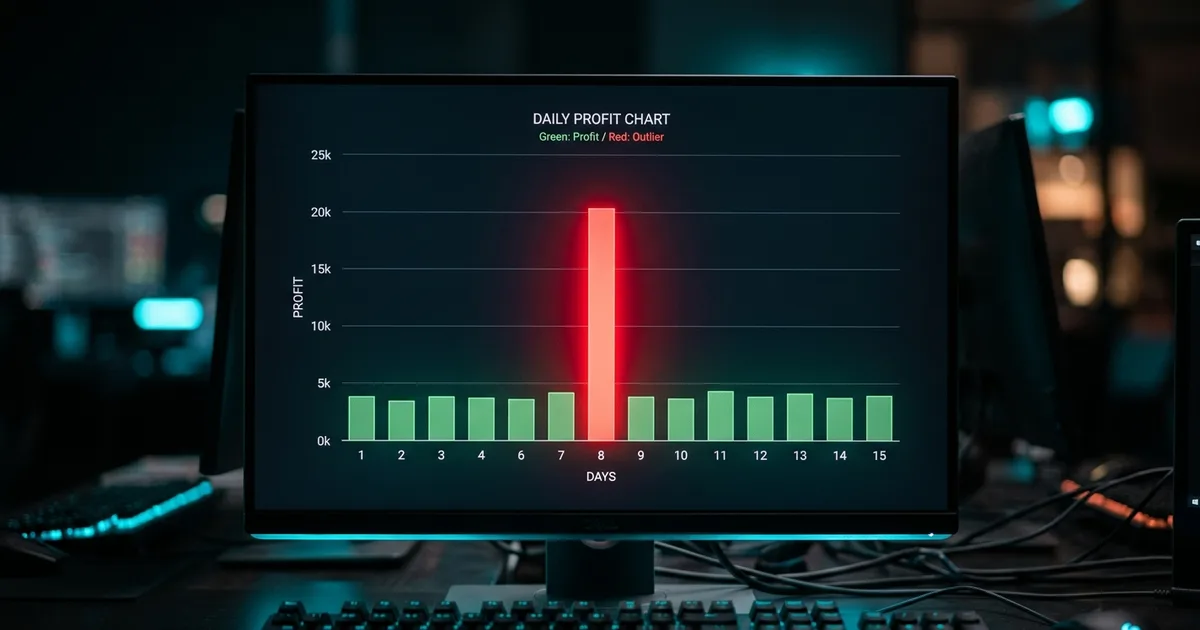
A trader hits their profit target, requests a payout, and gets told to wait - one single day made too much of the total. That's the consistency rule, and it trips up more profitable accounts than any drawdown breach does. It doesn't care that you were net profitable. It cares how that profit got made, day by day.
What a consistency rule actually caps
A consistency rule sets a maximum share of your total profit that any single day is allowed to contribute - commonly somewhere around 20-40% of the total, though the exact figure and calculation method vary by firm. If your best day accounts for more than that share of your overall profit, the account fails the consistency check even though the account is net profitable overall. The rule isn't measuring whether you made money. It's measuring whether you made it the same way, repeatedly, rather than once.
Why firms check for this at all
A firm paying out a funded account is betting you can repeat the performance. One outsized day tells them almost nothing about that - it could be genuine skill, or it could be one oversized, lucky trade. Spreading profit evenly across many days is a much stronger signal of a repeatable process, which is exactly what a firm is trying to underwrite before it hands over real payout money.
Six ordinary days and one outsized one. Even though the week is net profitable, Day 4 alone supplies more than the cap allows - and that single day is enough to fail the consistency check.
Bar chart of profit across seven trading days against a dashed consistency-rule cap line. Six days are unremarkable and stay under the cap. Day 4 produced a much larger profit that rises above the cap line and is flagged as exceeding the maximum share of total profit a single day is allowed to contribute, even though the account is net profitable overall.
How the math actually works
Take your total profit across the evaluation or funded period, then check what percentage came from your single best day. A firm with a 30% consistency rule fails an account where one day supplied 45% of the total - even if every other day was calm and profitable. The fix isn't to trade worse on your good days; it's to make sure your other days contribute enough that no single session can dominate the total. More consistent position sizing across the board does this automatically.
The mistake that trips people up
Traders chase the profit target and stop checking the math behind it. A single lucky trade that clears half your target in one session feels like progress - until the payout review flags that same day as a consistency violation. The number to watch isn't just total profit, it's the distribution of that profit across days. Check where your biggest day's contribution stands relative to your total before you request payout, not after it's rejected.
Consistency rules are about the shape of your trading, not just the total - and that shape is invisible if you're only watching your account balance. Every trade Qloner copies lands in the Event Log with the price and timestamp it executed at, so you can actually total up profit by day across every connected account and see whether one session is carrying more of the number than your firm's rule allows - before you're the one finding out the hard way at payout review.
Frequently Asked Questions
A consistency rule caps the maximum percentage of your total profit that any single trading day is allowed to contribute. If one day exceeds that share, the account can fail the consistency check even though it's net profitable overall.
More posts